Automated ETL Pipeline on GCP
An engineering project delivered during my Data & AI internship at Infosys (London) — not a public product. I built a production-style, five-DAG scheduled pipeline on Google Cloud Composer / Apache Airflow that turns a raw CSV into an analysis-ready BigQuery table, with idempotent loads, per-stage retries and no manual steps. It shows how a reporting layer can update itself reliably once the pipeline runs.
Case Study 4 — Automated ETL Pipeline on GCP Cloud Composer (Infosys)
The Problem
The team needed a repeatable, scheduled data-warehousing workflow on GCP — raw files landing in cloud storage, then cleaned, loaded and aggregated into BigQuery without anyone touching it manually. Doing this by hand doesn't scale: it's slow, inconsistent, and the moment someone forgets to run a step the downstream reporting is stale or wrong.
What I Built
An end-to-end automated ETL pipeline on Cloud Composer (Google's managed Apache Airflow), split into five DAGs so each stage is independently retryable and observable, running daily on a schedule:
| # | DAG | What it does |
|---|---|---|
| 1 | data_ingestion_dag | Reads the raw vgsales.csv from a GCS bucket and writes a combined dataset back to storage |
| 2 | data_cleaning_dag | Deduplicates and drops incomplete records, writing a processed_dataset.csv |
| 3 | bigquery_dag | Loads GCS → BigQuery via GCSToBigQueryOperator with an explicit 11-field schema and WRITE_TRUNCATE |
| 4 | bigquery_vgsales_aggregation_dag | Runs a CREATE OR REPLACE TABLE … AS SELECT to build a summary table aggregating sales by year and genre |
| 5 | (environment DAG) | Installs/pins the Python dependencies the workers need so tasks run reliably |
16,598 raw records flow through ingestion → preprocessing → transformation → BigQuery load on every run. Cleaning drops 307 incomplete records, so 16,291 rows land in the curated table, and the aggregation builds a 389-row summary table grouped by year and genre. (De-duplication removes nothing on this particular source — it's already unique — but the step stays in the DAG so a future dirtier extract can't silently double-count.)
The Techniques
- Modular DAG design — one responsibility per DAG, with
retriesand aretry_delay, so a transient failure in one stage doesn't force a full re-run. - Explicit BigQuery schema definition — all 11 fields typed and moded (
Rank,Name,Platform,Year,Genre,Publisher, and the five regional/global sales measures) rather than relying on autodetect. - Idempotent loads —
WRITE_TRUNCATEplusskip_leading_rowsmeans re-running the pipeline produces the same table, never duplicates. - In-warehouse aggregation — a
BigQueryInsertJobOperatorbuilds the curatedsummary_tablewith SQL inside BigQuery, so the heavy grouping runs where the data lives instead of being pulled into Python. - Vectorised pandas for the cleaning step, and batch processing to cut execution time.
Engineering the pipeline to be reliable
Two engineering problems had to be solved for the pipeline to run dependably in a managed Airflow environment — both are the kind of thing that decides whether a pipeline survives production:
- Deterministic BigQuery loading. Relying on schema autodetect makes ingestion fragile — column types drift and loads reject rows. I defined the schema explicitly in the operator (all 11 fields typed and moded) and used
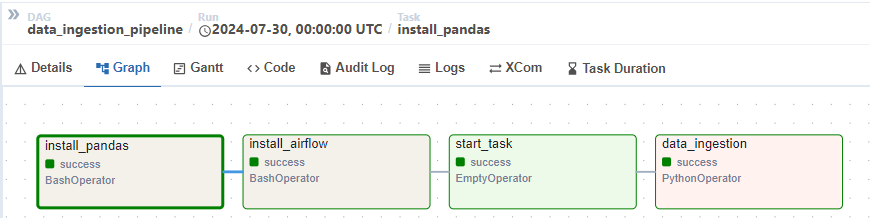
WRITE_TRUNCATE, which made every load validated and idempotent. I then added pre-aggregated summary tables so downstream queries read clean, typed columns instead of scanning raw data. - Reproducible worker dependencies. Cloud Composer workers need their Python libraries provisioned reliably or tasks fail to import. I handled this by developing installation scripts in Google Cloud Shell, uploading them to Cloud Storage, and executing them through Airflow — with dedicated
install_pandas/install_airflowtasks in the DAG and custom test scripts to verify module versions.
Throughout, I kept my manager and stakeholders updated on progress and risks early, with root causes and a mitigation plan, rather than surfacing problems late.
The Impact
- Delivered on time, running end-to-end on schedule.
- Fully automated, scheduled pipeline — raw CSV in GCS becomes an analysis-ready BigQuery summary table with no manual steps.
- Reliable and repeatable — idempotent loads and per-stage retries mean the same run produces the same result.
- Faster execution after rewriting the preprocessing with vectorised pandas and batch processing.
- Query performance improved by designing typed schemas and pre-aggregated summary tables, so analysts query a small curated table instead of scanning raw data.
What's in this case study
- Architecture diagram — GCS (raw) → Cloud Composer / Airflow DAGs (ingest → clean → load) → BigQuery (curated → summary).
- Pipeline Code Highlights — a curated, syntax-highlighted excerpt of the actual DAG code (project IDs and buckets redacted).
- Airflow screenshot — the data-ingestion DAG running green end-to-end in the real Composer environment, including the
install_pandas/install_airflowdependency-provisioning tasks. - Interactive run demo (
pipeline-run-demo.html) — replays a full scheduled run: all five DAGs moving through the scheduler, a task failing and recovering on retry, and the BigQuery tables it produces. Real task IDs, real retry settings, and the real vgsales row counts; the UI itself is a mockup.